What a 12 Seater Urbania Actually Solves
Twelve people is a strange number in Rajasthan. It’s too many for a car and a small van without someone permanently feeling like the overflow, and it’s nowhere near enough to justify a big body running half empty. Twelve is the size where the group is still one conversation — one driver, one bill, everybody hearing the same joke at the same time. What the vehicle decides at this headcount isn’t whether you arrive together. It’s whether hour six of a Jaipur–Udaipur run is pleasant or endured.
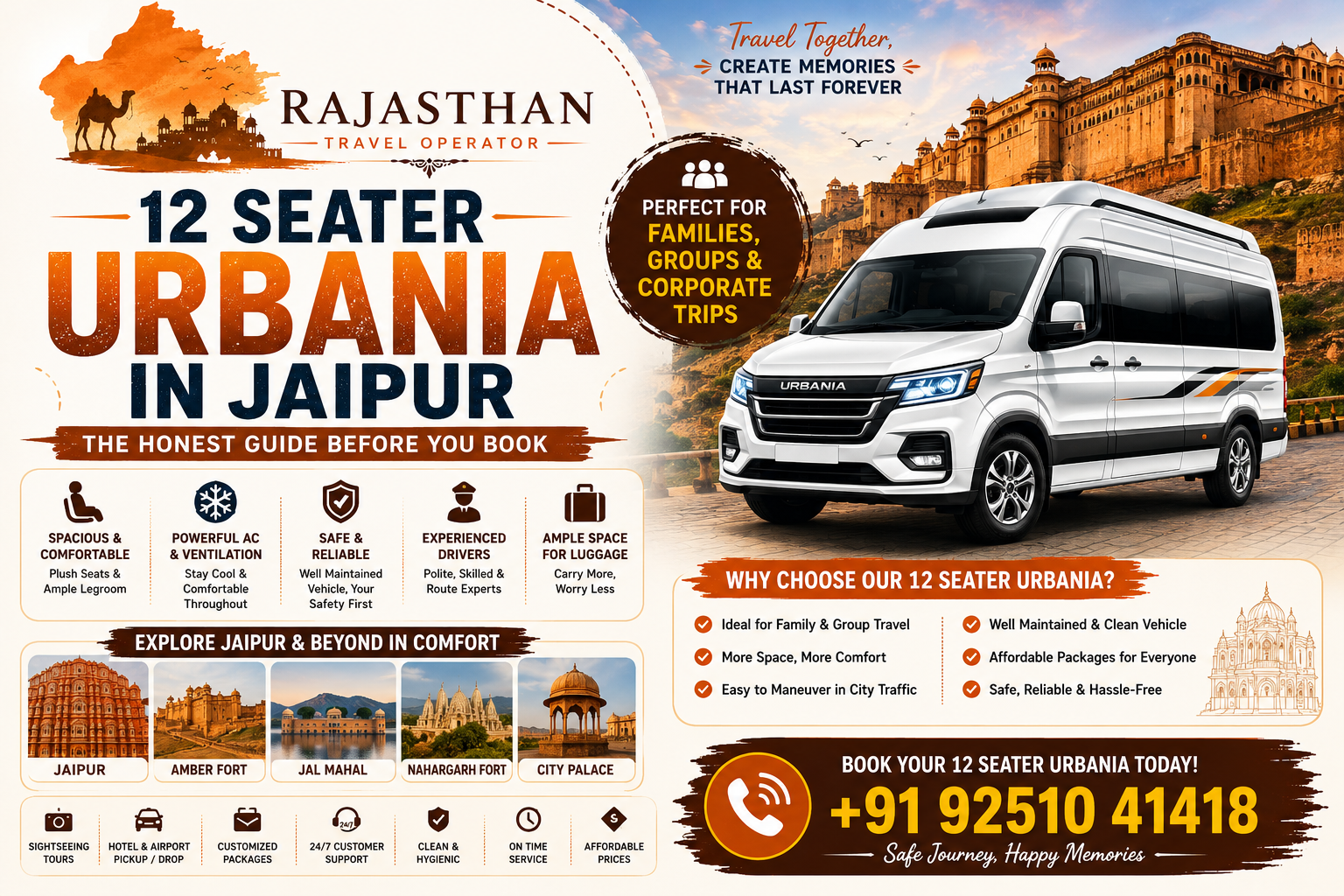
The Urbania’s answer is structural, not decorative. It’s built as a monocoque — one welded shell, the way a car is — where a conventional tempo traveller is a cabin bolted onto a ladder chassis. That single difference does most of the work you’ll actually feel: a lower floor, a step-in that elderly passengers can manage without a hand under the elbow, standing headroom in the aisle, less body roll through the ghats, and far less of the drumming and rattling that makes a standard-body day feel longer than the odometer says it was.
And that’s also the catch, stated up front: you pay for all of it. A 12 Seater Urbania in Jaipur costs meaningfully more per day than the standard 12-seater. On a two-hour city circuit, you will not get that money back in comfort. On a four-day desert loop with two sets of parents in the party, you’ll get it back by lunch on day one.
The Seat Math at Twelve
Twelve Urbania seats behave better than twelve tempo traveller seats — the seats are wider, the recline is real, and the gap between rows isn’t a negotiation. So unlike the bigger bodies, twelve here genuinely means twelve adults sitting comfortably.
Luggage is where the honesty is needed. The Urbania has no roof carrier. It can’t have one — there’s no ladder frame up there to bolt a rack onto, and that’s the price of the monocoque ride quality. Everything you’re carrying goes inside, behind the last row and under legs. So the working number splits in two directions: twelve adults for city duty, airport runs, corporate transfers and one-night trips with cabin bags, but ten to eleven adults once you load real multi-day suitcases, a pram, wedding shopping and the inevitable box of mithai.
Count accordingly. If the confirmed list is twelve with heavy bags and the budget is tight, the standard 12 seater tempo traveller with a roof carrier is the more sensible machine, and the 12 seater tempo traveller hire in Jaipur page covers exactly what that trade looks like. If the list is nine or ten people who want the best possible ride, the 9 seater Urbania with Maharaja seats is the better spend — fewer, bigger chairs beat more, smaller ones. And if the group is genuinely fourteen or more, stop reading this page and look at the 16 seater Urbania instead of squeezing.
Where the 12 Seater Urbania Sits in the Fleet
Right at the comfort end of the mid-size bracket. Think of the Urbania tempo traveller as a separate platform rather than a fancier version of what you already know — different construction, different ride, different price band. The 12-seater is its sweet spot: big enough for a full family or a client team, small enough to stay nimble in old-city lanes and hotel porches where a bigger body has to park down the road and make everyone walk.
Trim varies more than people expect. Some Jaipur fleets run 12-seater Urbanias in a plain pushback layout; others run them as proper premium builds with individual seating, ambient lighting, curtains, a fridge and a decent music system — what the market sells as the luxury Urbania tempo traveller in Jaipur. Those are not the same vehicle at the same rate, and the photographs on a WhatsApp broadcast rarely tell you which one is coming. Ask which build you’re getting, by name.
One more distinction worth keeping straight: a Maharaja seat tempo traveller is a seating configuration, not a chassis. You can find Maharaja seating inside a standard body, and you can find a plain bench-ish layout inside an Urbania. Comfort comes from the combination, so ask about both. The whole ladder, every size and trim, sits on the tempo traveller on rent page.
Who Should Book It — and Who Shouldn’t
Book it if the plan involves distance. Jaipur to Udaipur, Jodhpur, Jaisalmer, Mount Abu, the full Golden Triangle — anything where people are seated for five hours or more, and especially anything with parents, grandparents or small children on board. Book it for client and corporate movement where the vehicle is part of the impression you’re making. Book it for airport transfers of guests you’d rather not apologise to. Book it when the group has done a standard tempo traveller trip before and came back with opinions about it.
Think twice if the trip is twelve people with maximum luggage and a fixed budget. You’ll be paying premium rates and still solving a boot-space problem in the parking lot. The standard body with a roof carrier wins that specific fight.
Think twice also if the route ends on genuinely broken approach roads — some village temples, some interior stretches near Bhangarh and beyond Sariska. The low floor that makes the Urbania comfortable also makes it less forgiving of a bad last kilometre. Ask the operator plainly whether this vehicle has been to your exact destination.
Skip it if the real requirement is capacity, not comfort. Wedding logistics with eighteen guests to shuttle is a job for the 20 seater tempo traveller and nothing else — one full cabin beats two half-empty premium ones, every time.
The Routes Where It Earns Its Keep
Jaipur–Udaipur and Jaipur–Jodhpur. Long, fast highway with enough hours in the seat that suspension stops being an abstract concept. This is the Urbania’s home turf.
The Golden Triangle. Jaipur–Agra–Delhi with a family of ten or twelve, three days, hotel to monument to hotel. Comfort compounds across a multi-day itinerary in a way it never does on a single run.
Ranthambore, Pushkar, Ajmer weekends. Two-and-a-half to four hours each way on decent roads, usually with mixed ages in the party. The vehicle disappears into the background, which is exactly what you want from it.
Airport and corporate duty in Jaipur. Guest pickups, delegation movement, event shuttles. The step-in height and the interior finish do quiet work here — people notice the vehicle they were sent, whether or not they say so.
Khatu Shyam Ji and Salasar darshan for families who want the trip to be restful rather than merely completed. Just confirm the parking and approach situation for your dates, because mela-week traffic changes the maths for every vehicle in the fleet.
Before You Book — Five Things in Writing
Confirm it’s an actual Urbania. This matters more here than anywhere else in the fleet. A well-kept standard tempo traveller with recliner seats and LED strips gets quoted as “Urbania-type” or “luxury Urbania” more often than the industry likes to admit. Ask for the RC and the model name on it. The luxury Urbania in Jaipur label should describe a vehicle, not a mood.
Photos of the vehicle assigned to you. Cabin, seats, boot, exterior — dated, not brochure stock. Ask for the RC year as a plain number while you’re at it. How fast that answer comes back tells you as much as the answer.
Your luggage plan, in advance. Say out loud how many large suitcases are coming, and let the operator tell you whether twelve people plus that pile actually fits. No roof carrier means this conversation has to happen before departure, not in the driveway at 5 a.m.
Kilometre cap and beyond-cap rate. Usually 250–300 km a day. Multi-city Rajasthan itineraries cross it routinely. Get the per-km figure in the same message as the quote.
One all-inclusive number on WhatsApp. Tolls, state permits, parking, driver food and stay, night charges. Two quotes that look far apart are usually the same total, dressed differently.
Frequently Asked Questions
How many people fit comfortably in a 12 seater Urbania? Twelve adults for city runs, transfers and light-luggage trips. Ten to eleven once everyone brings a full multi-day suitcase, because there’s no roof carrier and it all rides inside.
Is the Urbania really better than a tempo traveller, or is that just marketing? It’s a real difference, and you feel it on long highway hours — monocoque body, lower floor, less roll, quieter cabin. On a two-hour city day, most passengers wouldn’t be able to tell you which one they were in.
What does a 12 seater Urbania cost per day in Jaipur? There’s no honest fixed number. Kilometres move the price more than days do, and trim level moves it again. Send the exact itinerary and ask for one all-inclusive figure.
Is a driver included? Always. Self-drive doesn’t exist in this category in Rajasthan. Just confirm the driver allowance is inside the quote rather than waiting at the end of it.
How early should I book? Four to five days in normal season. Seven to ten around wedding muhurats, Diwali, the Pushkar fair window and long weekends — good Urbanias are a small share of any Jaipur fleet and they get committed first.
Final Word
The 12 Seater Urbania in Jaipur is a comfort decision, not a capacity decision. If your problem is fitting people in, a standard body solves it for less money. If your problem is that twelve people have to be pleasant company after six hours on the Udaipur highway, this is the vehicle built for exactly that, and no amount of extra cushioning in a ladder-frame cabin will match it.
So decide honestly. Count your people with their bags actually in hand, look at how many highway hours the itinerary really contains, ask for photos and the RC year of the vehicle that’s coming to your gate, and get one all-inclusive number in writing. Do that, and the trip starts going right well before anyone gets in.